


On November 11th, Dr. Wahls was part of the TEDx conference in Iowa City, TED: ideas worth spreading. Using the lessons she learned at the subcellular level, she used diet to cure her MS and get out of her wheelchair.The following video is her entire TEDx speech:

picture source: ted.com
I loved doing Tae Kwon Do and was once a national champion. A lot has changed since then. I became a physician, had a son, and then a daughter. I developed a chronic, progressive disease for which there is no cure.
 In 2000, when I was diagnosed with multiple sclerosis, I turned to the best MS center I could find: the Cleveland Clinic. I saw the best doctors, received the best care possible, and took the latest drugs.
By 2003, my disease had transitioned to secondary progressive MS. I took the recommended chemotherapy, I got my tilt recline wheelchair. I took Tysabri and then Cellcept, but I continued to become more severely disabled.
I was increasingly afraid, for both myself and my family, because I was moving toward becoming bedridden.
Wanting to forestall that as long as I could, I began searching PubMed.gov for the latest research articles. I knew that brains afflicted with MS shrank over time.
So I spent a few minutes each night reviewing animal models of three other disorders in which the brains shrink: Huntington’s, Parkinson’s and Alzheimer’s. In all three diseases, mitochondria do not work very well, which in turn causes the early death of brain cells and shrinking brains.
With more searching, I identified studies where mouse brains and their mitochondria had been protected using fish oil, creatine and coenzyme Q. I translated those mouse-sized doses to human-sized ones and began my first round of self-experimentation. The rapidity of my decline slowed and I was grateful, but I was still declining.
I discovered the Institute for Functional Medicine, and through their continuing medical education course, Neuroprotection: A Functional Medicine Approach to Common and Uncommon Neurologic Syndromes, I learned more about brain cell biology and what I could do to improve mine. This is some of what I learned.
picture source: sharpbrains.com
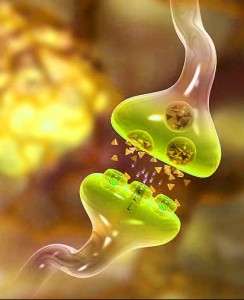
This is a synapse, the junction between the brain cells. The golden drops are neurotransmitters, the molecules that activate the next brain cell in line. To make neurotransmitters efficiently, our brain cells need an ample supply of vitamin B6, which is pyridoxine and sulfur.
These are mitochondria. They are critical to our lives. Each one of our trillion cells has many, sometimes thousands of tiny mitochondria, which manage the cell’s energy needs. Without mitochondria, we could all be no larger than bacteria. In medical school I had to memorize countless reactions involving mitochondria, but I was never taught which substrates our cells can manufacture and which ones must be consumed to ensure those reactions happened properly. For mitochondria to operate at peak efficiency, they need an ample supply of B vitamins, sulfur and antioxidants. So I added sulfur and antioxidants to my list of vitamins and supplements.
Next, I decided that I shouldn’t be relying just on pills; I should be getting the long list of nutrients I was currently taking in pill form from my food instead because, in so doing, I’d likely pick up other important nutrients that science had yet to identify and name. Plus, I thought it likely that vitamins occurring in food were more powerful than the synthetic versions I was taking in pill form.

picture source: npr.org/templates/story/story.php?storyId=5005952
What are most Americans eating? We will start with you. Think back to the last 24 hours and add up all of the vegetables and fruit that you have eaten. Do not include corn or potatoes. Raise your hand if what you ate could cover a dinner plate. Keep it up if you could have covered 2 dinner plates. How about 3 dinner plates?
This photo is from the book, Hungry Planet, by Peter Menzel and shows a week’s worth of food for this American family. You do not see many fresh vegetables or berries. Instead there are many boxes and bottles of processed foods. Most of their calories will come from white flour, sugar, high fructose corn syrup and meat. This is how most Americans are eating and it is how most societies eat as they become affluent. It also explains why as societies become affluent their health often declines.
This graph is from Dr. Loren Cordain, a top nutrition researcher. It depicts what percent of Americans fail to get the recommended daily allowance or RDAs of vitamins and minerals. The vitamins are the lower half of the graph and you can see that half of us do not meet the RDAs for B vitamins, vitamin C or vitamin A. The minerals are on the top half and two-thirds of us do not meet the RDA for calcium, magnesium, zinc or iodine, and 80% of us do not getting enough omega-3 fatty acids.
Life is a series of complicated chemical reactions. If we are not eating the vitamins, minerals and other building blocks needed for those chemical reactions, structures do not get made, or they get made improperly. This causes our health to decline—our children are born with jaws that are too small, leading to crooked teeth and smaller brains, emotions become uncontrollable, blood vessels become stiff, the heart muscle weakens, and we age too rapidly.
This is why one in three children, one in two if you are African American or Hispanic, will become diabetic as children or young adults. This is why our schools have ever increasing numbers of kids with severe behavior and severe learning problems. But it doesn’t have to be this way.
 For 2 ½ million years, before the dawn of agriculture a mere 10,000 years ago, our ancestors lived off what they could gather or hunt—a combination of leaves, roots, berries, wild game and fish that was locally obtained, in season and fresh. There was no grain, no dairy and no potatoes in their diet. The foodstuffs were very different, adapted to each locality. The Inuit in the far north ate very differently than Africans. Yet each of these primitive societies had diets that provided 2 to 10 times the daily recommended allowance for vitamins, minerals and essential fatty acids. These hunter-gatherer diets—also called Paleo Diets—have the most nutrition per calorie consumed, more than the American Heart Association diet, more than the American Diabetes Association diet and more than the USDA food pyramid diet.
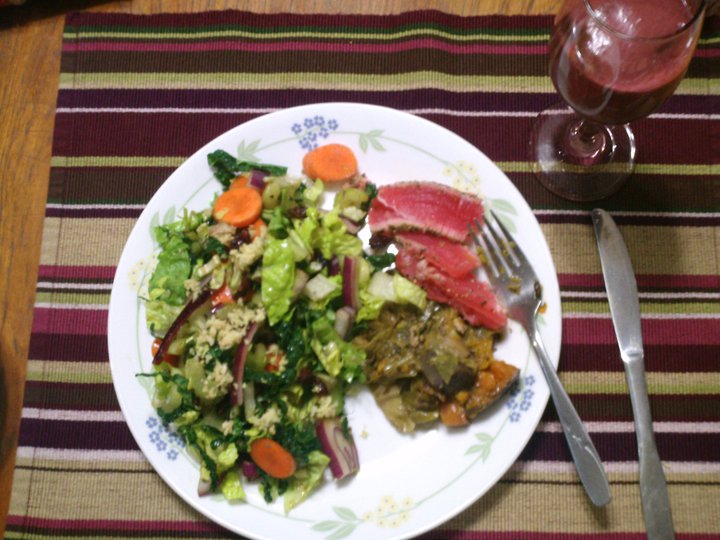
Primitive societies know more about eating for optimal health than modern scientists or physicians. I therefore started with the hunter-gatherer diet, and structured it to be sure I was getting an ample supply of the nutrients I had identified as important to the brain. It is 3 cups green leaves, 3 cups sulfur rich, 3 cups color, grass fed meat, organ meat and seaweed.
Here is how I did it. Three cups of vegetables equals a dinner plate heaped high.
I start with 3 cups or a plateful of greens every day because they are potent sources of B vitamins, along with vitamins A, C and K. Think Green B-A-C-K. They are also rich in minerals.
The B vitamins support your brain cells and your mitochondria. Vitamins A and C help protect you from cancer, and vitamin K helps keep your blood vessels and bones healthy. Minerals are important co-factors to hundreds of different enzymes used by your cells to conduct the business of life. Eating a plateful of greens every day markedly reduces your risk of cataracts and macular degeneration. My favorite green is kale. Other great greens include parsley, lettuce and spinach. Have more salads, green smoothies, or dehydrator kale chips.
Next I recommend 3 cups or a plateful of sulfur containing vegetables each day. Sulfur is important to our brains and our mitochondria. Our liver and kidneys use sulfur as they remove toxins from the bloodstream. Good sources of sulfur include cabbage family vegetables – cabbage, broccoli, cauliflower, collards, radishes, and turnips. The onion family is also rich in sulfur – that includes garlic, leeks and chives. So are mushrooms and asparagus.
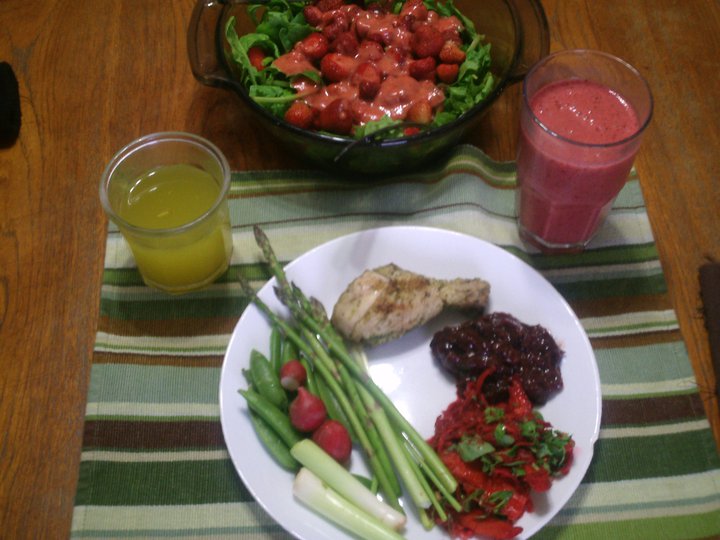
Another meal by Dr. Wahls
I also want you to have high quality protein that is rich in omega-3 fatty acids. The myelin, the fatty insulation around the wiring in your brain, needs omega-3 fatty acids. You also need omega-3 fatty acids to ensure a healthy jaw, straight teeth and a larger brain. Eat wild fish, especially salmon or herring, and grass-fed meat or wild game.
The hunter-gatherers prized organ meats, which are potent sources of minerals, vitamins and coenzyme Q, which is particularly important to mitochondria. Have liver, heart or other organ meats once a week. The primitive societies traveled great distances to ensure access to seaweed, which is rich in iodine and selenium. Iodine is important to the manufacture of myelin, the insulation in the brain and to the excretion of toxins by the liver. In addition, having adequate iodine stores lowers the risk of breast cancer and prostate cancer. Studies have shown 80% of Americans have inadequate iodine stores in our bodies. Have some seaweed every week to restore and maintain healthy iodine levels.
People often can’t imagine eating 9 cups of vegetables a day. But if you eat your 9 cups of vegetables, three platefuls before having any grain or potatoes or dairy, you have dramatically increased the vitamin, mineral and essentially fatty acid intake in your diet. In addition, food allergies and sensitivities to gluten, the protein in wheat, rye and barley, and to casein, the protein in milk, are vastly under-diagnosed, and have been linked to a wide variety of health problems, including but not limited to asthma, eczema, infertility, depression, migraines, fibromyalgia, behavioral problems and neurological problems.
Yes, it does cost more to eat vegetables. But you will pay the price either way—for food that restores your health and vitality or for doctor visits, drugs, surgery and loss of work due to health problems.
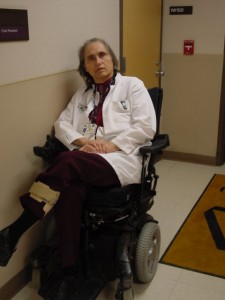 For seven years, while receiving the best care from the best doctors, despite taking the latest, newest drugs, I grew steadily weaker and ever more disabled. In November 2007 I could not sit in a standard upright chair as you are now. I needed to be fully reclined or in bed. I could take a few steps using two canes and was losing my keys and phone repeatedly. I was having nightmares that my clinical privileges were revoked. That is when I created a diet specifically for my brain cells and my mitochondria.
In January 2008, just three months later, I could walk between exam rooms using just one cane. By March, I could walk throughout the hospital without a cane. In May I got on my bike for the first time in nearly a decade, and rode it around the block. In September, I rode my bike 18 miles. The following year I did a trail ride in the Canadian Rockies.
Not everyone will deteriorate to the point of needing a wheelchair. But everyone’s health declines if they starve their mitochondria. I am the canary in the coal mine, here to bring you this warning.
We have all have a choice to make. We can continue eating processed foods and watch both ourselves and our children grow steadily more overweight, depressed and disabled. We’ll watch as healthcare costs balloon out of control and threaten to bankrupt us individually and collectively. Or we can eat for our mitochondria.
 My choice is to teach the public about the healing power of food and continue doing clinical research, testing the impact of my interventions in others with progressive MS. So far our early data are very promising.
My dream is that someday soon, physicians and patients, coaches and athletes, employers and employees, policy makers, parents and young people, will all understand that becoming healthier, growing stronger, faster, and smarter, begins not with drugs or medical procedures, but with eating the way our DNA expects.
I challenge you to eat for your mitochondria and become ambassadors for the power of food to restore health and vitality.
If I can rise up from a tilt recline wheelchair by changing the food I consume, and now that we’ve seen similar results in others, stop for a moment and imagine what eating for one’s mitochondria could do for restoring the health and vitality of the people you love, your community, your country and your world. Just imagine.
We all have a choice to make.
What will yours be?
By Dr. Terry Wahls
 Dr. Wahls' Amazon Top Seller: "Minding My Mitochondria"
Buy Minding My Mitochondria at Amazon and learn how to begin implementing the Wahls Diet™ today!
Dr. Wahls' Amazon Top Seller: "Minding My Mitochondria"
Buy Minding My Mitochondria at Amazon and learn how to begin implementing the Wahls Diet™ today!
Pingback: Dr. Wahl’s Diet | Feelngroovy
hi i have MS and a friend just sent me this…i know because i have been doing some of this diet its been working…now going to have a re-think on all of every thing i eat…thanks
Richard
I was diagnosed with MS about 7 years ago and immediately began the Swank Diet – much of which seems to reflect Dr Wahl’s approach, and I have faired relatively well in the course of the disease. I look forward to reading Minding My Mitocondria. Am wondering, Dr Wahl’s, if you are medication free.
I am so thankful for your work and example, one of the most important happenings in the world today, I believe.
I have ms, and have changed my diet to a hunter gatherer one, 90% i would say, and i intend to go 100% for my own health, I have to admit which is why i am writing today, that christmas is here and more temptations, I thought, “ah that will be okay” i will just have this and that food item, full of sugar and gluten, today a day after ,my walking has taken a new drop in weakness, I thought , can it really happen that fast, a reaction in my body, well i guess it can, so i re listened to your video ,re-encouraging me to keep going and even up the amount of good foods , So thankyou, and I wish you and your family a wonderful new year. If i was very rich i would create a place where people can begin this diet, taught what is good to eat, how to build muscles up, meditation, healing. But as i do not its in my wish list hehe
greetings Carol
I read your book three times and changed my eating habits instantly after watching your video ! After making fun of alternative medicine etc…for many years, I have changed my way of thinking all because of you. I am curious if you see your way of eating as a cure for PCOS of a dear female relative who is very thin and eats relatively well but still has elevated male hormones…? All the best to you and thank you for changing my life around !
Right on right on right on! This hit the nail on the head! I am a massage therapist in N.D. & have a passion for building people up. Thank you for posting this. It’s exactly what we need to hear!
This is such great advice, Dr. Wahls is giving to us and it makes perfect sense. The body can’t fight back if it hasn’t the strength to do so. I know it’s hard to get used to the lifestyle change especially with costs so high for fresh produce. I do recommend going organic, if you are able to do so. If you can, plant your own garden as soon as you are able. The health benefits of gardening might encourage more exercise, increasing your heart rate plus the fresh air will do you wonders. Seeds are cheap! This would help lower the costs of the lifestyle change that she recommends. I use the Back to Eden garden method which makes it so much easier to garden. No hassle, very few weeds and very little water required throughout the year. In following Dr. Wahls advice over the last few months I have regained my energy levels, my mind is much clearer, I haven’t had as many attacks, even the mild ones are fewer and farther in between. Thank you Dr. Wahls!
Michelle
Fascinating information that I intend to pass on to those I know who have MS, my family and friends. I have had the good fortune to meet several wonderful women while obtaining home care for my 90 year old mother. By example they have taught me good eating habits that mirror your theories. while reading your blog (one of the first that I have ever read, and the only one in its entirety) I grabbed a plate of spinach and kale and beets. you are an inspiration. thank you for sharing and I wish you continued good health.
Janelle
Hello Again Terry …., So I don’t miss your email — Please write “Natural Health Info”
in the subject line….. and send to > [email protected]
Look forward to hearing from you soon, Thomas
Hello Dr. Wahl and Good Day!
Terry, I take my hat off to you! Also, after 37 years of research in Natural Health, I found the most profound answers to Real Health, that was right under our noses for years. A good friend of Linus Pauling PhD, was fortunate to receive a visit from someone who was on a “path” to finding the “right answers” himself.
It’s amazing how similar the information is to what you layed out in your video. I am soooooo proud of you for your vision and forth right approach. I would like to share this Valuable information with you.
Please email me at [email protected] or the address above, and I’ll be more than happy to share this with you. You really deserve to know. I believe with your knowledge and this valuable information, you can help a lot of people across the world. It has made such and impact on the quality of my life, my family, and thousands of others, that I quit everything else I was doing; and am committed to sharing this with everyone who wants to know. – Thomas
Dr. Wahls, do you have any thoughts about the effectiveness this diet might have on the progression of ALS?
Thanks,
Steve
Are you familiar whith theSwank MS diet?
Yes there are many books out there that “claim” to be paleolithic. However, you can not just pick any one. It is like any new idea. People see that something sells and they want a piece of the pie. Many of these books have erroneous nutritional information and/or include foods that are not paleolithic, such as canola oil (which is really not very healthy) and diet soda!!
Dr. Wahls, six weeks ago I became somewhat numb and “tingly” from the waist down. It is not going away as the doctors hoped. Based on a recent contrast MRI, my neurologist in Cedar Rapids, IA thinks I may have MS. However, she is unwilling to confirm MS yet. Her plan is to wait 2 months and perform another MRI to see if there is scarring. I am frustrated waiting for answers and am very interested in starting your diet to help my body heal. Before I buy anything, I would like to know if you would recommend one of your DVD’s or your book, “Minding my Mitochondria” . I am looking for the detailed specifics on how to implement/prepare your food recommendations. Thank you so much for your time.
Dr. Wahls-Recently I lost two friends from cancer and started investigating changing my own diet as a preventative measure. I am very unhealthy. I have asthma, acute lymphodema of the legs with elephantitis like rashes, Barrett’s esophagus, Plantars, spastic colon and hiatel hernia symptoms, occular migraines, severe arthritis due to a near fatal car accident and lastly I am 340 lbs. I have decided if I don’t figure out how to take better care of myself I won’t live very long. SOO diet is huge right now. When I heard you describe the symptoms of a Gluten allergy-I have ALL of those.
Where do I get a copy of a Gluten free diet to try out. I’ve started changing the fruit/ veggie comsumption of the whole family. Need to turn back the clock here.
You are amazing!!Kelly Swieca
Kelly,
If I were you, I would immediately start to consume ONLY fresh organic and mostly raw vegetables as Dr. Wahls suggested. You don’t need a copy of a diet to follow. Just get yourself to a farmers market or a healthy market with a great produce section and fill your refrigerator with ONLY vegetables and some fruit! Eat only fresh fruit in the morning. Make youself a fruit salad using mostly berries as they are lowest in sugar. Then eat salads or LIGHTLY steamed veggis for your other meals including all the veggies she mentioned and no dairy or grains. Also include a small portion of a wild caught fish or grass fed meat at some of your meals. You will be amazed at how these foods will satisfy and fill you up. If your diet is full of processed and packaged foods, you will be making a huge lifestyle change, but is sounds like you owe it to yourself and you family to do that ASAP! Be creative in your combinations of veggies in salads until you find something that you love and will crave as much as some of the foods that are making you ill. Get a good quality organic extra virgin olive oil and use it on your salads with a whole lemon squeesed and fresh raw garlic. This makes a delicious healthy dressing. Add avocado as well. Most importantly, there is no need or use for any other food than fruit veggies and pure healthy meats. There are many books out on the Paleo diet or hunter gatherer. Or just research it more on the internet. It is simple so don’t confuse yourself with specific diets, just start eating the foods she discussed and stop eating all the other ones! Great luck to you!! Get healthy!!
Laura
Dr Wahl, I’ve watched the video a couple of times now and am going to incorporate this foods into our diet. My husband has AD and I think this would be helpful. How do you buy seaweed and how do you prepare it to eat? Thank you for inspiring me to take action.
Carol
dr. does the pain ever stop?
I was first diagnosed in May of 2000, after 8 years of looking for answers to my odd symptoms. I was in a wheelchair by October, 2003. My children were 18 months, 3 and a half, and 7 and a half. I went through Avonex and Rebif with no help. The exacerbations continued and I was up to 2 grams of Solumedrol for 3 to 5 days each time. After being refused PT by my Neurologist, I was hopeless.
I turned to my faith in Christ, and I changed Neurologist. I was started on Copaxone and did my own exercises using my children to help strengthen my arms and legs. Soon I was on a Rollator walker, then a standard walker, and by 2006 I walked well with one cane. The new Neurologist challenged me to walk unaided if I wished to return to work as a RN.
April of 2007, I returned to work, though not as a 12 hour night shift charge nurse in the Step Down Unit, ER, or ICU as I had before. I worked in Hospice and truly loved guiding families through what could have been such turbulent times. In May of 2009, I realized my fatigue level was increasing and I sought a desk job. I worked following the medical care and treatment of patients overseas, as well as arranging evacuations and repatriations as indicated. But in July of 2011, I lost my job.
When I lost my job, I lost my insurance and my Copaxone. I have had 3 exacerbations, including my first bout with Optic Neuritis. I would love to purchase your book, but I have little to no resources. I make 425 from a person who rents a room in my home. My children and I finally get food stamps and Medicaid. I am awaiting Disability approval, but they are hesitant because I improved and returned to work. Is there anywhere that may have it for a less expensive price? Just point me in the right direction please. I would be most appreciative.
Truly,
Teresa
A used bookstore (or online used books) may have it. Also try eBay.
Dr Wahls,
I have rheumatoid arthritis which, like MS, is an autoimmune disease that results in inflammation. I am keen to try your diet, but have two questions: (1) Would you suggest any modifications to your diet to make it more specific for rheumatoid arthritis? (2) Would you have a list of equivalent foods from the tropics (I live in Southeast Asia)?
Thanks,
Cheryl
Good on you girl, back on the skinny ski’s. You’re a legend. I cannot put your book MINDING MY MITOCHONDRIA down!
Our brain is still trying to repair the damage being done by the immune cells. My approach is to reduce the inflammation by going gluten free, dairy free (and ideally grain free) and provide more of the building blocks to repair the myelin. Both are necessary. Learn more about why and what you can do in my book MINDING MY MITOCHONDRIA (amazon). .
Dr. Wahls,
I am so happy for your recovery and it’s easy to imagine that switching to a nutrient-rich (and junk-poor) diet such as the one you describe would have a dramatic impact on anyone’s health. The one point in the argument that confused me was that–as I understand it–MS is an auto-immune condition in which the body mistakenly forms antibodies against its own myelin, causing the destruction of that vital tissue. Your body may need B-vitamins and sulphur, etc. to produce myelin but inadequate myelin production (whether due to nutritional deficiency or any other cause) does not appear to be the problem in this disease.
One hundred and more years ago. People did not know more about eating than we do. They ate what was available. It was effective because in earlier generations, people who did not process what was available efficiently were sickly or died without having children. That is how evolution works. There are some foods available today that are better than any hunter/gatherer could/can get.
Smoothies made with bananas,kale,berries & milk comes to mind. A plate with medium rare steak, potatoes, vegetables and fruit is a balanced meal. Avoid foods that are processed to the point that nutrients are removed.
Dr Wahls…you did not state if your food was steamed or raw. Kale is kinda tough to eat raw. What was your preparation primarily.
Thank-You!
-Pam Z
Hello Pam,
I believe she recommends Kale Chips (dehydrated overnight below 105 degrees). I personally try to juice once a day and I generally like to include 2-4 raw organic kale leaves, including the stem.
-Jt
So glad I came across your story. I was diagnosed with Crohn’s disease at the age of 4 in 1979. After 25 years, seven surgeries, multiple meds, my disease went into remission and has stayed in remission for 8 years now. I changed my diet and some lifestyle factors and am a big believer that we have a lot of natural options we are underutilizing.
Do not exceed 1/4 teaspoon without having a physician monitor your thyroid status. For some the additional iodine and selenium can increase the effectiveness of making thyroid hormones, leading to too much thyroid (or rarely too little) hormone in the bloodstream.
I have your book, Minding My Mitochondria, and wanted a little clarification on your recommendation for the amount of daily sea weed. What do think is appropriate in ounces? Maybe I missed it, but I only saw teaspoons on the chart.
Thanks,
Pam
I am a vegan and was wondering how I would adapt your eating plan to be sure I was getting enough protein and Omega 3 fatty acids.
Thank you, Dr. Wahls for your talk. I recently lost my mother to sepsis, due to MS. She had been living with the disease for more than 30 years and her last 14 years were spent living in a nursing home. Over the years she tried everything to treat her MS; whatever drugs were available, whatever vitamins or supplements that were rumored to help, and she just steadily got worse. The only thing she didn’t try was changing her diet. She ate mostly packaged foods and sweets. She said her doctor told her that diet had nothing to do with MS and she believed him. Begging her to improve her diet had no effect.
I urge everyone with MS reading this page to do what Dr. Wahls suggests, no matter how hard it seems to do. Maybe you will still get worse, who knows? But you can’t truly say you’ve tried everything if you haven’t tried this. I wish the best of luck to all MS patients.
I have no clinical trials of my protocol in cancer patients. However, eating for one’s mitochondria improves the health of our immune cells, which in turn will be more successful (likely) at killing rogue cancer cells.
I have stomach cancer and would like to know whether following you eating plan would prevent the cancer from growing. Thanks. Really enjoyed your talk.
Rodger
If you go to http://www.terrywahls.com and go the wahls foundation page there, sign up for the research page. You will then see the abstract that was presented. Bottom line 7 of 9 had marked improvement in their fatigue.
Hello Dr. Wahls. I saw your video today regarding your recovery from MS. I’ve had MS for close to 10 years now with no complications (outside of pain here and there and of course fatigue). I have been taking Beta Seron to cope with the disease. For the most part I have had no problems. But one day after watching a documentary called, “Food Matters” and other documentaries I realized that eating natural was the only way to go. I had a chance to test this one time when I caught a cold. It might not be advisable with todays doctors but I decided NOT to take cold medicine but to take a high dosage of vitamin C (6k mg a day), eat ONLY raw foods like the vegetables you suggested and more. Eat some fruit and drink a lot of water and of course sleep. I did this for two days and my cold was completely gone! I had the typical symptoms of a cold including slight fever. I did it naturally and of course no side effects. At that point I decided to become a vegetarian. It’s been great!
Then I saw another documentary called, The Beautiful Truth – The Gerson Cancer Cure. I don’t have cancer. But, I found some of the information in it was helpful. I saw a lot of documentaries after that. The most recent being, Fat, Sick and Nearly Dead. Now it may seem like I’m easily influenced but I’m not. I’ve just been sort of like you in that I’ve been searching for more natural remedies because I felt the body can cure itself if given proper nutrition. I’ve seen in the documentary The Beautiful Truth where Type 2 Diabetes was cured. And of course so was cancer.
Now, I’m not writing to debate these things. I can only go off of personal experiences. And I found that the better my nutrition, the better my MS. At one point I went 5 months without taking my medicine because of my diet! It was great. Then I became unemployed. I’m collecting unemployment but it’s about to run out. Anyway, my diet changed. I’m still a vegetarian but, I’ve had to cut back on consumption since I haven’t had enough to eat as much as I use to.
Why am I writing you? Because I would like to know where can I get the information regarding the results from your case studies for the people who had MS? You had mentioned that you would reveal the results at the 2011 Neuroscience Conference. Of course your video is old now so I’m looking for those results.
(sorry for the “book” but I was just excited and wanted to share a little of my story. That it’s true – nutrition can be a cure)
- Loki D. Wolf
There is considerable overlap between the diet that reduces problems with MS, depression, obesity, heart disease and the diet that reduces the risk for cancer. You can turn to my book MINDING MY MITOCHONDRIA for more details on the protocol and methodology.
I am sharing this with everyone I know every way I know how, including two friends with MS. This is wonderful information and gives me great hope.
I have breast cancer. Any tips onthat?
Look into Medical Marijuana. Watch “Run from the Cure ” on you tube. Your body uses chemicals in an extracted oil (not smoked) to cause the cancer cells ONLY to self destruct. No side effect. Look into it, as it is kind of miraculous!
Ellen, Cancer is basically a disease caused by an overload of toxines and an underload of nurishment. You can fix that by isolating yourself from junk food. Eat only what is a fruit, a low starch vegetable (greems.yellows, red, oranges etc) or a nut. On top of that take 13 glasses of fresh made juices of varied vegetables and fruits. Drink 8 oz every hour to mantain your immune system well nurished and killing cancer cells faster than they can reporduce themselves. Drink 2 oz of whater with the juices or in between. Make nut milk on your blender by puting a hand ful of nuts and a cup of water and blending it well. Then strain it in a cheese cloth or nylon strainer. Its better digested and you get more benefit from nuts that way. (Nuts like almonds, pecans, brazil nuts,walnuts, etc… no peanuts)
I am just a normal person that reads a lot yet I was able to heal a neighbour that believed in the program I wrote for him from the things I had learned reading. He had been sent home to die because there was nothing doctors could do for him any longer. He had an inoperable Lymphoma behind the stomack and AIDS that he got from taking drugs as a Teenager. Imagine having AIDS and having Chemo… He nearly died. But with this simple program that he adopted with the help of his family he was decleared well in 5 month. He has been back to work for the last 10 years. Keeps his healthy diet and doctors say he no longer has AIDS either. If you still think you should have Chemo, do yourself a favor. Prepare your body for it by starting your juicing and healthy eating a month prior and continuing all through Chemo. God bless you…
Congratuations to Dr Wahls. It’s a wonderful story. May your testimony be of help to many a sufferer. God bless you…
I have lost a few good friends and relatives to cancer – some too young and I can’t believe that simple diets can make a difference. Recently, my brother-in-law was diagnosed with cancer in his colon and it was sugerically removed.He is now contemplating chemo because the doctor couldn’t guaranteed that he got all the cancer. Any advice?
Ellen-
You have stated very generally that you have cancer, and while your privacy is important, no one can properly advise you without more detail. I am not asking you to uncover your personal health just know that what Dr Wahl has expressed for treating MS, basically the same is true for most degenerative disease. Get rid of processed food; if it is man-made don’t eat it! Stick to whole foods such as fruit and veg and legumes; whole grains, nothing white and/or bleached. Plenty of purified water. While juicing is good, be mindful of any diabetic issues you may have and the overall sugar content of fresh fruit when juiced. Cancer loves sugar. Sugar is public enemy #1 (it destroys our immune system for one–something a cancer patient cannot afford) to everyone but especially those with cancer. Eliminate all processed sugar from your diet.
Some good reading resources are Forks Over Knives by Gene Stone, Your Body Speaks Your Body Heals by Santillo and Eat to Live by Fuhrman MD. You can get them all on Amazon.com
I hope this helps. I will be praying for you.
-Pam
Nutrition & Wellness Consultant
AFPA
HOW DO i get a diet that I can follow?
.. how do I GET a diet that I can follow???
Weight loss is not the point with Dr. Wahls. Optimum health IS. What she is demonstrating is not a DIET, but a lifestyle change away from processed foods (if the packaging states what the ingredients are, 99% of the time, it is a processed food) toward the healthier veggies, meats and fruits that were predominant in the American food supply as recently as six generations ago. Soooo, read closely what she has to say, shop accordingly and eat as much of it as you want. No need to DIET.
However, I did lose 25 lbs in two months, and never once did I feel deprived, simply because when I sensed hunger, I ALWAYS ate. Plus, my energy has soared and being a 67-yr-old gramma, this is a great way to celebrate senior citizenship. Lifestyle change is the responsibility of the individual and requires reeducating yourself about what you put in your body. It’s a great journey! If you want it, it’s right in front of you.
watch “cancer is curable now” and then get “smart DNA test”
good luck
Dr. Henry Bieler was saying that according to his experience 80% or more of breast cancer was due to the burned proteins of coffee and that uric acid (with a metal taste) was excreted from nipples long before the cancer is visible. Nonetheless he was sure that toxic protein with lack nutrients from green veggies were the cause of all cancers.
Recently the researcher in Nuclear Medicine, Giuseppe Nacci M.D., conducted successfully research on 24 patients applying specific diets. His approach and consideration are in this PDF http://www.center4cancer.com/pdf/nacci-food-nutrition.pdf
Even if this post is old and you could be already healthy, consider to find an honest family doctor who can review Nacci, Whals and Bieler work and decide with you a dietetic approach. Constant monitoring of blood and urine is fundamental. Please, NEVER follow an approach “do-it yourself” and never follow a diet program without a doctor well informed on body chemistry during detoxication from cancer ot other forms of chronic disease.